
SEPT - Vol. 1, No. 1

THE WEIGHT OF LOVE
By: Abegail Byun
In this photo, my childhood stuffed bunny rests on my grandfather’s backpack during a family trip. I was only two or three at the time, too small to carry it myself. He was a man of few words, and most of the memories I have of him come from after his Alzheimer’s diagnosis. Seeing this moment, before the illness touched him, brings me joy—it reminds me that even in silence, love is carried in the simplest gestures.
THE WEIGHT OF LOVE
BEAUTIFUL
By: Ella Vick
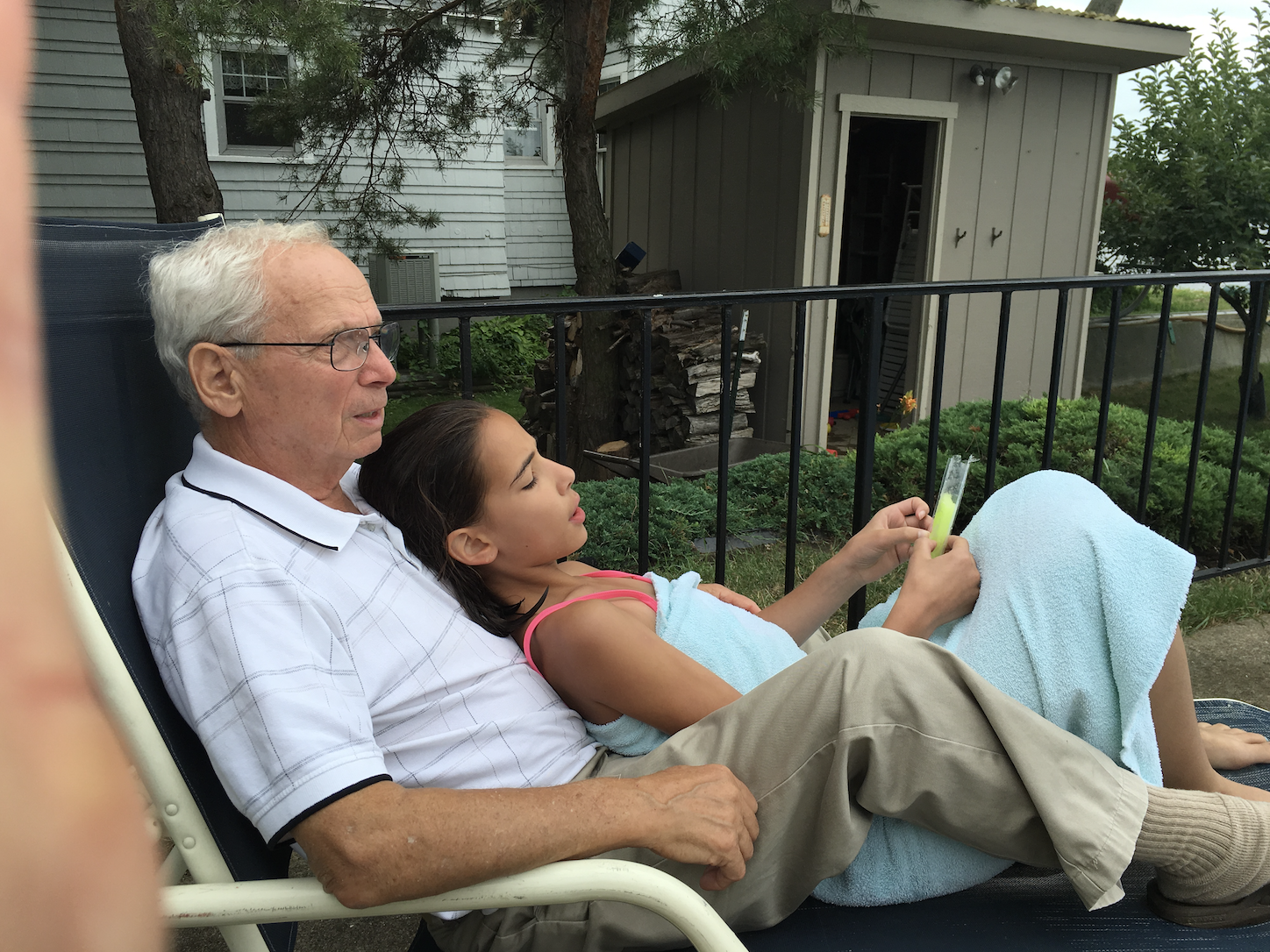
In January of 2021, both of my grandparents got Covid and ended up in the hospital at the same time. They miraculously survived, though we soon discovered that Covid had exacerbated my Papa’s dementia in a staggering way when he was rediagnosed from stage two to stage six.
When asked, my family and I describe Papa as a butterfly, clueless but flitting around happily. Unfortunately, this is often not the reality. He feels that something is off, but he can’t identify what it is. This inability makes him angry. He asks me what grade I’m in every few minutes, and he has begun to have frequent emotional outbursts. I have watched the man I know die though his body is still here on Earth.
Yet Papa smiles and looks at me with love in his eyes whenever he sees me, even when I can tell he is fishing for my name. He holds my hand quietly when his brain is tired from working out puzzles all day that he will never be able to solve. In these moments, I swear that the single thing he remembers to be true is love. I can feel his love for me when he is silent and it is absolute. Papa has taught me to never waste an opportunity to tell someone you love them.
I want to share with others that when everything else in this world falls away, when faced with a degenerative disease that forces people to forget, love will remain. I am so grateful for all of the years I told Papa I loved him because, if I had just started now, it would be too late. To anyone reading this, I implore you: tell your people that you love them every chance that you get.
Alzheimer’s Awareness Bracelet
By: Shannon Taylor
Be afraid
do not
hold my hand
here I am
crazy
understand me, you are not
even trying
I love you without
anything in return
I do not want
to be here
I want
someone to help remember
I am
alone
you are not
memories are fading
even though
the clock has not run out
confusion and fear
will drive away
my purpose
(now read from bottom to top)
An Interview with Dr. Omar Ahmed

-
One of the key symptoms that happens in pretty much everyone who lives with Alzheimer's is something called spatial disorientation. It’s essentially the inability to find your way home. People will get lost in even familiar surroundings. They’ll know if they’re on Main Street, and they’ll know their home is on State Street. They simply will not know how to get there. This is not the same thing as having a memory deficit. They know they're on Main Street; they recognize it. They know exactly where they are—they simply cannot figure out how to get home. The brain region involved in that deficit is not the same region that most people think of as involved in memory deficits, which is the hippocampus. The hippocampus, when impaired, leads to memory deficits, but the brain region relevant to our research is called the retrosplenial cortex. Our interest in Alzheimer’s disease comes from our interest in understanding how the retrosplenial cortex works in healthy individuals and what happens to it when it malfunctions in models of Alzheimer’s disease. Then the question is how to repair whatever deficit is found, and what we can learn that can then help people. This symptom is pretty debilitating because, at the end of the day, people will not be able to go from room to room in their own house. You can imagine how, even at the earliest stages of Alzheimer's disease, that can be very disorienting and disconcerting. This is the symptom we are trying to understand from a basic neuroscience perspective, so that we can suggest some translational solutions.
-
This brain region has fascinated me for a good fifteen years now. As a postdoc, I was just doing some experiments related to this, and they seemed really fascinating. It wasn't the right time to study it, so I knew that when I started my lab, the whole lab would focus on this brain region and how it works, and then how it gets impaired in different settings. I just saw something and kind of knew that that’s what I wanted to understand.
-
Many people will hear of terms related to plaques and amyloids, and those proteins are definitely involved. When their numbers increase in neurons, neurons stop functioning the way they used to. Let’s think of it simply that way. What causes them to go up remains an area of research. There are things that are happening even before those proteins go up. There’s a chain reaction of neurons that start to fail. Their synapses (connections through which neurons communicate) onto other neurons start to fail, and the standard, if you will, way of processing information in the brain, of making sense of the world around us, of remembering things or finding our way around, all of that starts to fail because the neurons that support those functions can no longer work the way they used to. It’s multifaceted; there are many, many points of failure. And amyloid and plaque are not the only things. To put it simply, in Alzheimer's disease, a key set of neurons that control many other neurons fails, causing perception and memory to be impaired as these neurons fail.
-
Let’s preface this with a caveat—I am not an M.D., but I’ve spoken to many M.D.s on this. I think that question comes up for everyone: What can we do on a daily basis that decreases the probability of our brain developing Alzheimer’s-like phenotypes? Often, some of the most consistent answers that you'll get from clinicians are exercise and sleep. There are a few things that are better than that. You’ll hear many stories about things like needing to do a sudoku puzzle every day—I think all of those are just kind of different views on the same viewpoint, which is to keep using your brain. Keep it healthy; keep it active. Exercise is great for that, and sleep is just crucial. Neurons are almost like batteries: they run down over the course of a day, and you need to sleep to recharge them, to be able to use them. Constant sleep deprivation can manifest as many different disorders. Sleep and exercise are the short answer, and there are probably many other things that clinicians will tell you. Take their advice, not mine, but they will tell you those two for sure.
-
Unfortunately, I do not work with people living with Alzheimer's, but the Alzheimer’s Association, for example, has a great set of ways to approach conversations with people living with advanced Alzheimer's. I think treating them with respect is the number one answer there. Beyond that, I think it’s on a case-by-case basis. As long as the humanity of the individual is respected at all times, I think that’s the most important thing.
-
Anything I’m about to say doesn’t have anything to do with an immediate cure; let’s preface it with that. There are decades of work needed to go there, but we wouldn't be doing it if we didn't think there was hope down the line. This brain region, the retrosplenial cortex, has a type of neuron that literally does not exist anywhere else. We call it the low-rheobase cell, and the student who was involved in discovering it called it the “little neuron that could.” This neuron seems to be fundamentally important in encoding our sense of how we’re oriented in space. We’re doing our best to understand how this neuron fails in mouse models of Alzheimer's disease. And it does—we’re seeing there are deficits. And then we're getting neuroplastogen-type drugs to these mice, and we see that we’re able to repair at least part of this deficit in this mouse model. So, to understand the neurons in the retrosplenial cortex and how they are impaired in Alzheimer's disease is, for us, step one. And then step two is trying to repair those very specific impairments using mechanistically understood methods, not just randomly trying a drug. Why? Why should it work? I think that emphasizes that the way for good translational work doesn’t involve less preclinical work; it involves a lot more. Anytime we think something is going to work and then we say, “Let’s just go straight to a clinical trial,” that’s when failure happens. The better we understand how potential therapies work at all levels, the higher the likelihood of success at the translational and clinical level. And I think that’s something that needs to be respected, even if pharmaceutical companies are desperate to get a drug to market. We cannot skip the basic and fundamental translational neuroscience steps. It never works otherwise.
-
From my non-clinical perspective—I don’t want to overstep the limits of my own expertise here—I think we cannot lose faith in research. It’s what’s gotten us this far. Just today, there were some miraculous headlines about potentially a remarkable solution for Huntington's disease. It took decades. I mean, we’ve known the exact cause of the disease for decades, and we haven't been able to solve it. But now they are able to inject a particular construct directly into the brain, immediately benefiting individuals on a long-term scale. Sometimes we need to take the long road, unfortunately. I know that’s not a good solution for people who are living with Alzheimer's right now, and for them, hopefully ,there are other options available right now, medications that can work. But, for finding optimal cures, we have to do the hard work of understanding the system—the brain—inside out so that we can try to repair it rationally. Every symptom of Alzheimer's needs to be understood in its own right so that we can then try to understand how that particular symptom could be fixed, and maybe some solutions to different symptoms and alleviating those symptoms might be overlapping, but it’s going to take some time.
Note: This interview has been edited and condensed for clarity.
The OmarLab’s website, containing a list of the lab’s research publications, can be found at: https://www.omarlab.com
We want to thank Dr. Ahmed again for his contributions to the research base surrounding Alzheimer's and his willingness to sit down with us for this interview.
BAKE SALE
BAKE SALE
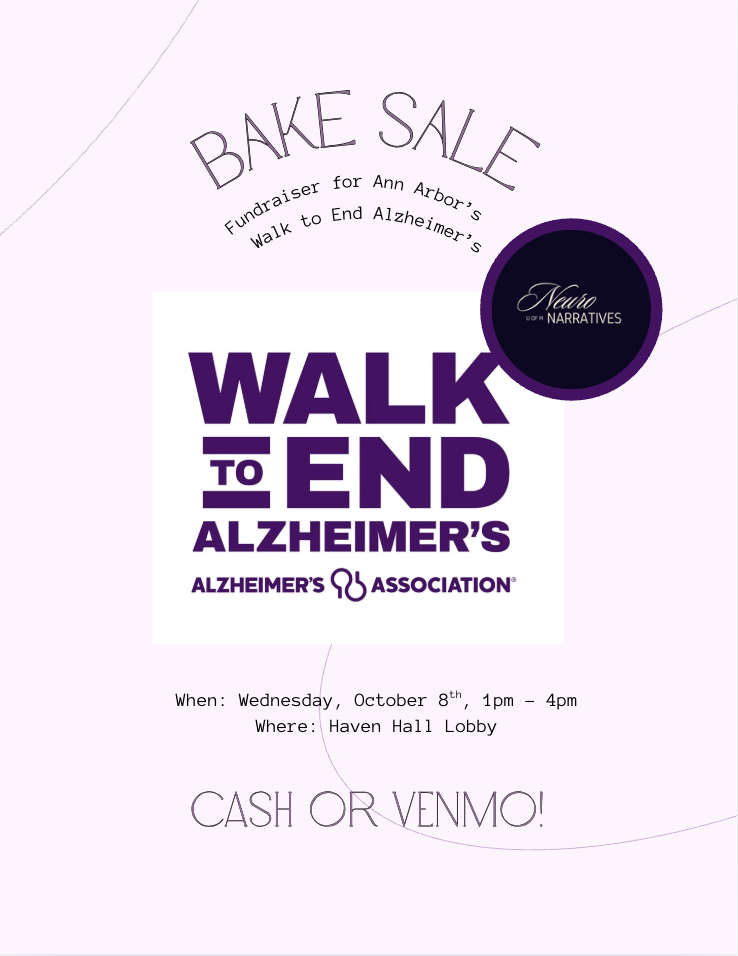
Join us for our bake sale fundraiser for Walk to End!
Click HERE to join our team and donate.
October 8
Haven Hall Lobby
Ann Arbor, MI